
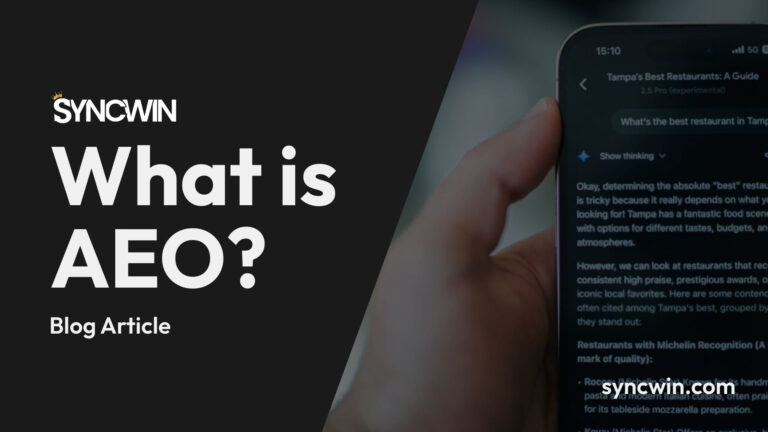
Answer Engine Optimization (AEO) is the practice of structuring your content so that AI platforms like ChatGPT, Google Gemini, and Perplexity can extract, understand, and cite it in their responses.
The goal is not a higher ranking in a list of links. The goal is to be the source that an AI references when someone asks a question relevant to your business.
Why AEO Matters Right Now
Think about how you searched for information two years ago versus today.
Most people, including me, have quietly shifted from typing queries into Google to asking ChatGPT, Gemini, or Perplexity directly.
The answer comes back immediately, synthesized, no tab-switching required.
That behavioral shift is not small.
Gartner projects a 25% decline in traditional search volume by 2026.
In 2025, zero-click searches (queries where the user gets the answer without visiting any website) already accounted for roughly 60% of all queries.
That means the majority of informational searches are being resolved before anyone reaches your website.
For a small business owner, that sounds alarming. To be honest, it should get your attention.
But here is what most people miss: the businesses that adapt early get disproportionate visibility.
AI platforms are pulling from a much smaller pool of well-structured, authoritative content than Google’s index does. If your content is built right, you have a real shot at being cited before the bigger players in your niche figure out what is happening.
The window is open right now. It will not stay open forever.
Who Is Already Feeling This Shift
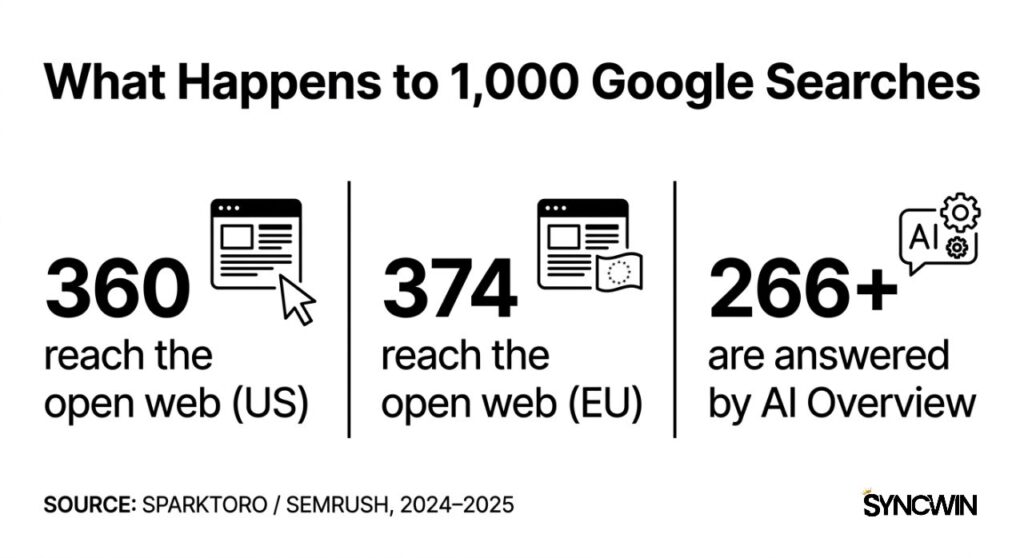
The behavioral change is not abstract. Here are the numbers behind it.
In the United States, 58.5% of all Google searches already end without a single click to an external website (SparkToro/Semrush, 2024).
For every 1,000 US searches, only 360 clicks reach the open web. For EU searches, it is 374. These are not projections; they are measured from tens of millions of real browsing sessions.
For B2B businesses specifically, the impact is sharper.
73% of B2B websites experienced significant traffic loss between 2024 and 2025, even when their Google rankings held steady. The rankings did not change. The behavior around them did.
AI search traffic is also growing at a rate that makes it impossible to treat as a side experiment.
Generative AI referral sessions grew 796% year-over-year from 2024 to 2025 (WebFX, analysis of 2.3 billion sessions).
Conversions from those sessions grew 6,432% over the same period.
That gap between session growth and conversion growth tells you something important: the people arriving from AI are not browsers. They have already been convinced.
In India, the picture is just as clear. India leads globally in small business AI adoption, with 59% of small and mid-sized businesses already implementing AI in their operations (Intuit & ICIC, 2026).
IBM’s India-specific data shows 59% of enterprise-scale organizations in India had AI actively in use in 2025, and 74% of early adopters had accelerated investment over the prior 24 months.
AI search is not coming to India; it is already here.
AEO vs. SEO: What Actually Changed
Before going further, one thing needs to be said clearly.
SEO is not dead.
Anyone telling you to abandon SEO for AEO either does not understand how AEO works or must be selling you something.
SEO is the umbrella.
AEO, GEO (Generative Engine Optimization), LLMO (Large Language Model Optimization), whatever the next acronym is, these are layers built on top of a solid SEO foundation.
You cannot implement AEO without doing SEO first.
The technical structure, the topical authority, the backlink credibility, all of that is what give AI platforms a reason to trust your content in the first place.
AEO does not replace that work. It builds on it.
Here is how the two approaches differ in practice:
| Feature | Traditional SEO | Answer Engine Optimization (AEO) |
|---|---|---|
| Primary goal | Rank in search results, earn clicks | Be cited inside AI-generated answers |
| Content focus | Long-form, keyword-optimized articles | Concise, structured “answer capsules” |
| Success metric | Organic sessions, click-through rate | Share of mentions in AI responses |
| How users interact | Browse multiple results | AI delivers one synthesized answer |
| Tech underneath | Crawler-based indexing, PageRank | Large Language Models (LLMs), RAG systems |
RAG (Retrieval-Augmented Generation): This is the system many AI tools use to pull in current information before generating a response.
Think of it as the AI doing a quick research pass before answering.
If your content is structured for extraction, it gets pulled in. If it is not, it gets skipped.
How I Got Serious About AEO
I did not come to AEO through a course or a webinar. I noticed it in my own behavior first.
I was using Google less. So were people around me.
The queries that used to take me five minutes of tab-switching now take thirty seconds in ChatGPT or Perplexity. That shift was happening without anyone announcing it.
Then, a friend of mine, Dev Chatterjee, a professional SEO at Inbound Medic, shifted his entire business focus from traditional SEO to AEO.
When someone who has built their livelihood on SEO makes that kind of move, you pay attention.
That was the signal for me to go deep on AEO: understand it, implement it on my own websites first, then teach it once I have something real to show.
I am currently running AEO experiments on my own sites and client projects.
When the results come in, I will publish them as case studies here. I am not going to write about results I do not have yet.
How AI Platforms Decide What to Cite
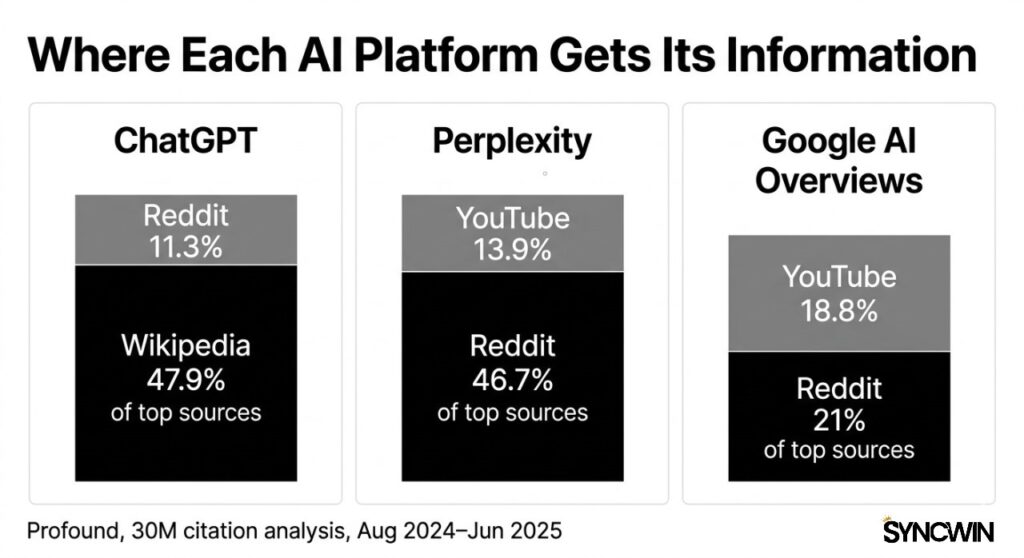
This is where most AEO guides go generic.
The reality is that ChatGPT, Perplexity, and Google AI Overviews each have different preferences.
A strategy that gets you cited in one may do nothing for another.
| Preference Types | ChatGPT | Perplexity | Google AI Overviews |
|---|---|---|---|
| Top source | Wikipedia (47.9% of citations) | Reddit (46.7% of citations) | Reddit (21% of citations) |
| Secondary sources | Branded domains, academic content | News sites, niche publications | YouTube (18.8%), Wikipedia (5.7%) |
| Content preference | Encyclopedic, hierarchical structure | Fresh content, front-loaded answers | Multi-modal (text + video + images) |
| Update cycle | Training data + occasional browsing | Real-time retrieval | Index-based, real-time |
Source: Profound analysis of 30 million citations across ChatGPT, Google AI Overviews, and Perplexity (August 2024–June 2025). The ChatGPT Wikipedia figure (47.9%) represents Wikipedia’s share of ChatGPT’s top 10 most-cited sources, not all citations.
What this means for a small business:
- For ChatGPT visibility: Your official website pages (About, Services, FAQs) carry weight. Structured, factual, well-organized content on your own domain is treated like a primary source.
- For Perplexity visibility: Fresh content matters. So do authentic mentions on community platforms. Encourage real customers to mention you on forums, local groups, and review platforms.
- For Google AI Overviews: Your existing SEO signals still matter, but video content now has a direct path into AI results. Even a simple, clear YouTube explainer about your services helps.
The Core Building Blocks of AEO
1. Answer Capsules
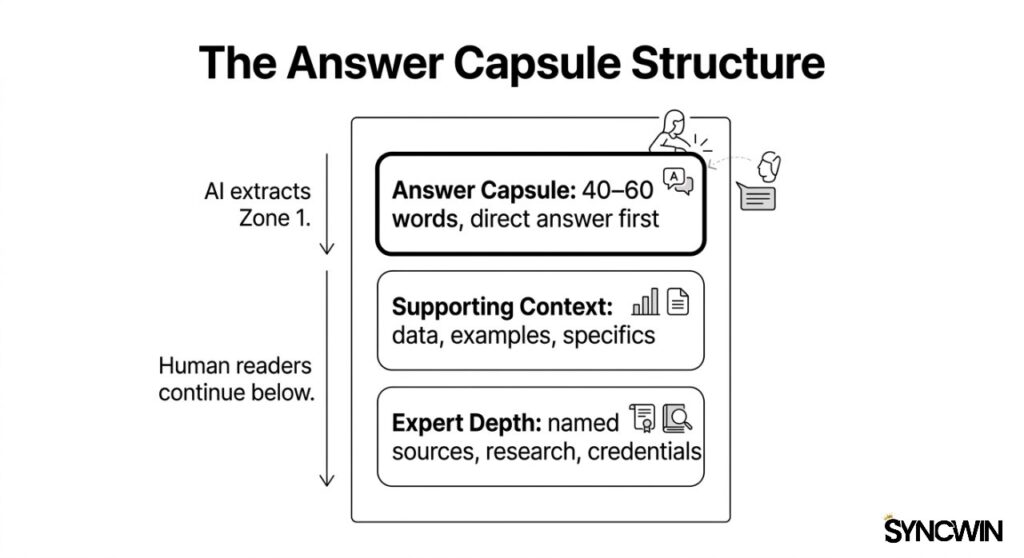
An answer capsule is a 40-60-word paragraph placed immediately after a section header that directly answers the question that the header implies.
AI systems break your content into chunks before processing it.
If the answer to a question is buried inside a long paragraph three scrolls down, the AI skips it. If the answer is right at the top, clean and self-contained, it gets extracted.
Example of a weak structure:
“When it comes to the topic of HVAC repair costs, there are many factors that determine pricing, including the type of unit, the complexity of the issue, and the local market…”
Example of an answer capsule:
“HVAC repair in Kolkata typically costs between ₹800 and ₹3,500 depending on the issue type. Refrigerant refills and filter replacements fall on the lower end. Compressor or PCB replacements push toward the higher end. Most standard service calls are resolved in a single visit.”
The second version can be extracted and read aloud by an AI. The first cannot.
2. Schema Markup
Schema markup is code you add to your website that tells search engines and AI systems what your content actually is, not just what it says.
Think of it as a label on a box. Without the label, the AI has to guess what is inside. With the label, it knows immediately.
The most important schema types for AEO:
- FAQPage schema: Maps question-answer pairs directly. The most effective way to get cited in AI responses.
- HowTo schema: For step-by-step content. Works well for service businesses explaining processes.
- Speakable schema: Marks specific sentences for voice assistant playback (Alexa, Google Assistant, Siri).
- Organization schema: Links your content to your verified business entity, which builds trust signals.
If you are on WordPress, plugins like Rank Math or Yoast handle most of this without writing code manually.
3. Semantic HTML and Page Structure
Semantic HTML means using the right HTML tags for the right content.
A heading should use an H2 or H3 tag, not just bold text.
A list should use an actual list tag, not dashes typed manually.
Data comparisons should use proper HTML tables.
AI systems parse code. When the structure is clean, extraction is easy.
When it is messy, your content gets ignored in favor of a competitor whose structure is cleaner.
One specific point worth noting: headers written as actual questions perform better for AEO than abstract topic labels.
Weaker: “HVAC Repair Costs” Stronger: “How much does HVAC repair cost in Kolkata?”
The second version directly mirrors how a person would ask an AI.
4. Factual Density
AI platforms prioritize content with verifiable claims.
Not opinions dressed as facts, but actual data points, statistics, specific numbers, and named sources.
A practical target: include a verifiable claim or specific data point every 150-200 words.
Not filler stats pulled from nowhere. Real numbers with real sources.
5. The llms.txt File
This is a relatively new standard (it emerged in 2024) where you place a plain-text file at your domain root (yoursite.com/llms.txt) that gives AI crawlers verified facts about your business: what you do, where you operate, what you offer, and what you do not offer.
It reduces the chance of an AI hallucinating incorrect information about your business.
Hallucination means the AI confidently states something false. It happens most often with niche businesses and recent information.
An llms.txt file is a direct countermeasure.
AEO for Small & Local Businesses
Local AEO is less about competing with national brands and more about being the most clearly structured, most factually consistent business in your area.
When someone asks Siri or Google Assistant, “Who does wedding catering near me in Salt Lake, Kolkata?”, the AI pulls from Google Business Profile data, local directory listings, and on-site content.
If any of those three sources conflict, your visibility drops.
Google Business Profile (GBP) as Your Local AEO Foundation
Your GBP is now a transactional layer for AI, not just a listing.
In India, Google’s AI mode already pulls from GBP attributes in real time: hours, services, pricing ranges, and review sentiment.
Two things that directly hurt local AEO visibility:
- NAP inconsistency: NAP stands for Name, Address, Phone number. If your business name on Justdial says “Sharma Events” but your GBP says “Sharma Events & Catering Pvt. Ltd.”, AI treats these as two different entities and loses confidence in both.
- Unanswered reviews: AI summarizes sentiment from reviews to make recommendations. A pattern of unanswered negative reviews signals low trustworthiness.
The local AEO gap is not specific to Kolkata. In the US, a WSI study found that local businesses and B2B SMBs are seeing the sharpest drops in organic engagement in years as AI Overviews absorb the queries that used to send traffic.
A bakery ranking first in Google for “gluten-free cupcakes near me” used to get dozens of clicks a day.
Now that same query can be resolved by an AI answer before anyone clicks anything.
What wins in both markets is the same: consistent business data, structured on-page content, and a GBP profile that functions as a real-time source of truth.
Local AEO Action Items
| Tactic | What to Do | Why It Matters |
|---|---|---|
| NAP audit | Check Justdial, Sulekha, IndiaMart, GBP for exact name/address/phone match | AI cross-references directories to verify legitimacy |
| Review management | Respond to every GBP and Facebook review, positive and negative | AI summarizes review sentiment to rank recommendations |
| Question-based H2s | Add a local FAQ section to your service pages | Mirrors conversational voice search queries |
| Hyperlocal landing pages | Create pages for specific neighborhoods or areas you serve | Builds geographic entity authority |
| Multilingual content | Add Bengali or Hindi versions of your About and Services pages | Captures regional language AI queries |
On India-specific data: I am currently working on local AEO projects targeting Kolkata across a lifestyle blog, a directory, and client websites.
I do not have hard numbers yet. When I do, I will publish them here as case studies.
I would rather tell you that honestly than cite data I cannot stand behind.
The Biggest Mistake People Are Making Right Now
Most people think AEO is a completely new discipline, and SEO is finished.
So they follow whoever is loudest on LinkedIn or YouTube about AEO, and they implement tactics that have no actual impact on how AI platforms retrieve content, because they skipped the SEO foundation entirely.
You cannot do AEO without SEO.
The technical health of your site, your topical authority, your backlink credibility: these are what give AI platforms a reason to trust your content at all.
AEO does not override those signals. It depends on them.
SEO is the umbrella term. AEO is one layer under it, alongside GEO, LLMO, and whatever comes next. The fundamentals do not change. The application does.
How to Measure AEO Performance
Traditional metrics like organic sessions will decline as zero-click searches grow. That is expected. What you track instead:
| Metric | What It Measures |
|---|---|
| Share of Model (SoM) | What percentage of AI responses in your category mention your brand |
| Citation Velocity | How quickly new content is being picked up by AI crawlers like GPTBot |
| AI-referred traffic | Sessions that arrive via AI platforms (visible in GA4 referral sources) |
| Review sentiment score | The tone AI uses when summarizing your business from public data |
Tools that currently track AEO metrics: Semrush, Profound, and HubSpot’s AEO grader.
One honest note: According to Semrush’s June 2025 study of over 500 high-value topics, AI-referred visitors convert at 4.4 times the rate of traditional organic search visitors.
The reason is simple: by the time someone clicks a link from a ChatGPT or Perplexity response, the AI has already done the research and recommendation work.
That user arrives pre-qualified.
A separate Ahrefs analysis of its own site data found AI search drove 12.1% of signups despite making up only 0.5% of total visitors.
The AI has already done the vetting before the user clicks. The volume may be lower, but the intent is much higher.
6-Month AEO Roadmap for Small Businesses
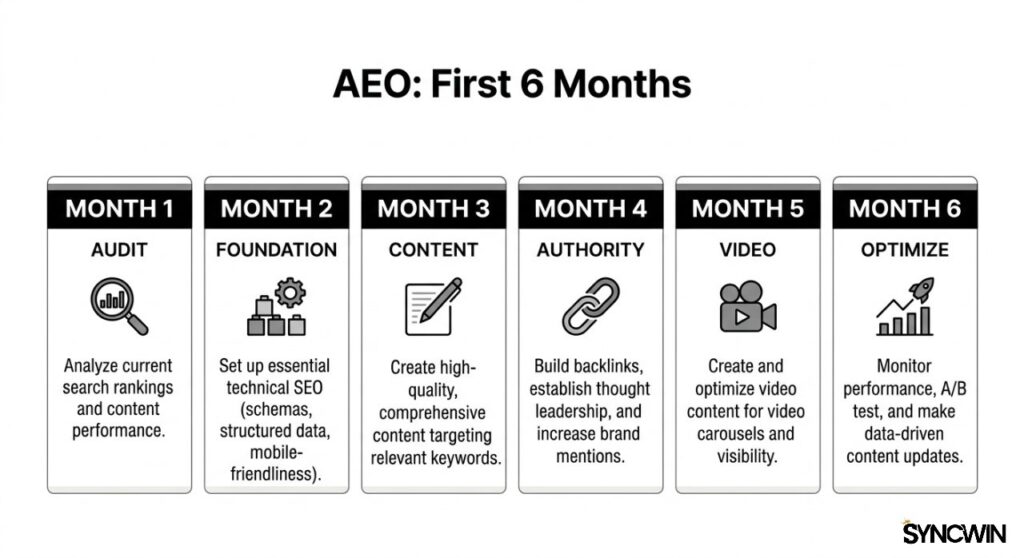
| Month | Priority | Specific Actions |
|---|---|---|
| Month 1 | Audit and baselines | Run a HubSpot AEO grade. Audit NAP consistency across Justdial, Sulekha, IndiaMart, and GBP. |
| Month 2 | Technical foundation | Implement FAQPage and HowTo schema sitewide. Add an llms.txt file to your root domain. |
| Month 3 | Content re-engineering | Identify your top 20 pages. Add 50-word answer capsules at the top of each section. Rewrite headers as natural questions. |
| Month 4 | Authority building | Earn 5-10 new GBP reviews with detailed service descriptions. Pursue 1-2 guest posts in relevant publications. |
| Month 5 | Multi-modal expansion | Create 3-5 short videos (under 60 seconds) explaining your core services. Publish on YouTube. |
| Month 6 | Optimization | Use Profound or Semrush to track citation velocity. Refresh top pages with current stats and named expert sources. |
Answer Engine Optimization (AEO) FAQs
What is Answer Engine Optimization in simple terms?
AEO is the practice of structuring your website content so that AI tools like ChatGPT, Perplexity, and Google Gemini can read it easily and cite your business when someone asks a relevant question.
Instead of trying to rank in a list of links, you are trying to become the source the AI quotes.
Is AEO different from SEO?
AEO is not a replacement for SEO.
SEO is the foundation: technical site health, topical authority, and backlinks.
AEO is a layer on top that helps AI platforms extract and trust your content. Without solid SEO, AEO tactics will not work.
Do I need to know coding to implement AEO?
Not necessarily.
If your site runs on WordPress, plugins like Rank Math and Yoast handle most schema markup without manual coding.
The bigger requirement is understanding how to structure your content and write answer capsules, which is a writing skill, not a coding one.
How do I know if my business is showing up in AI answers?
Search for questions your customers would ask in ChatGPT, Perplexity, and Google with AI Overview enabled.
See if your business is mentioned.
Tools like Semrush and Profound now offer structured tracking for this, called Share of Model or citation tracking.
Will AEO kill website traffic?
Informational traffic will decline as AI answers more queries without clicks.
However, the traffic that arrives from AI referrals converts at 4.4x the rate of typical organic traffic (Semrush, June 2025). Volume drops; quality rises.
The businesses tracking AI referrals as a separate GA4 channel are already seeing the math work in their favor. The strategy shifts from volume to quality.
How long does AEO take to show results?
Based on current industry data, meaningful citation visibility can begin appearing within 2-4 months of implementing the core technical changes.
Consistent results take closer to 6 months. This is comparable to the timeline for SEO changes to register.
What is an llms.txt file?
It is a plain-text file you place at your domain root (yourwebsite.com/llms.txt) that gives AI crawlers verified facts about your business.
It reduces the chance that an AI generates false information about your services, pricing, or location.
Is AEO relevant for small local businesses in India?
Yes, and arguably more so than for larger brands. Local AI queries (“best caterer in Ballygunge”, “AC repair near Howrah”) pull from GBP data and local content.
Small businesses with clean, consistent, well-structured local content can out-rank national aggregators in AI responses, which those platforms are built to resist in traditional search.
Conclusion
AEO is not a replacement for what you have already built.
The technical health of your site, the topical authority you have earned, the content your customers actually search for: none of that becomes irrelevant.
What changes is the layer above it.
Search engines are becoming answer engines. Your content either gets extracted and cited, or it gets skipped.
The platforms doing the extracting (ChatGPT, Perplexity, Google AI Overviews) each have different preferences, but they share one requirement: content that is structured, specific, and factually grounded enough for a machine to parse and trust.
That is achievable for a small business.
It is, in fact, one of the few areas where a small, focused operation can outperform a larger competitor by moving faster and building cleaner.
The six-month roadmap in this guide is a starting point.
Audit before you build. Fix your NAP data before adding schema. Add answer capsules before chasing citations. Do it in order, because each step depends on the one before it.
I am running AEO experiments on my own sites and client projects right now.
When the numbers come in, I will publish them here, honestly, including what did not work.
This space is new enough that real data from real implementations is more useful than any framework.
If your business is outside India and you want help implementing AEO from the ground up, SyncWin works with small businesses globally on SEO and AEO strategy.
From technical audits to schema implementation to content re-engineering, we cover the full process.
Get in touch with SyncWin, and we will tell you exactly where to start based on your current site.
If you are a business in Kolkata or anywhere in West Bengal, we work with local businesses directly: GBP optimization, NAP consistency across Indian directories, Bengali and English content, and full AEO setup.
We know this market. Contact SyncWin for local AEO services, and let’s start with an audit.
Drop any questions in the comments. I read all of them.