
SEO (Search Engine Optimization) helps your website rank in search results so people find and click through to it.
AEO (Answer Engine Optimization) structures that same content so AI platforms like ChatGPT, Perplexity, and Google Gemini can extract it and cite your business in their responses. Both work together.
Neither replaces the other.
Key Highlights
- 60% of Google searches end without a single click to any website (SparkToro/Semrush, 2024)
- In 92.36% of AI Overview results, at least one cited domain ranks in the top 10. But by early 2026, URL-level overlap between organic top-10 rankings and AI citations had collapsed to 17-38% (Ahrefs and BrightEdge, February 2026)
- AI-referred traffic converts at 14.2% vs 2.8% for traditional organic search (Averi, April 2026)
- CTR for top-ranked informational queries dropped from 1.76% to 0.61% when AI Overviews appear (Search Engine Land, November 2025)
- Content updated within the past 2-3 months is twice as likely to be cited by AI engines
- “SEO is dead” has been said for 15+ years. It is still wrong. SEO is now Search Everywhere Optimization
- 58% of US small businesses now use generative AI, up from 40% in 2024 (U.S. Chamber of Commerce, 2025)
- 51% of B2B companies globally are increasing AEO investment in 2025-2026, compared to only 14% increasing traditional SEO spend (Martal B2B Benchmarks, 2026)
- AI-referred traffic converts at 14.2% versus 2.6-2.8% for traditional organic search (Discovered Labs, 12M visit study, 2025)
“SEO is Dead.” Sure. We Have Heard That Before.
Every few years, a new technology arrives, and someone announces that SEO is finished.
Social media was supposed to kill it. Voice search was supposed to kill it. Now AI is supposed to kill it.
And every single time, the people making that announcement are either selling something new or do not actually understand what SEO is.
SEO is a set of standard practices that help you get found online. That is it.
The platforms where people look for information have expanded, so SEO has expanded with them.
It used to mean rank in Google search. Now it means get found everywhere online: Google, YouTube, Reddit, Quora, ChatGPT, Perplexity, Gemini, Instagram, and wherever else your customers are looking.
Search Everywhere Optimization. That is what SEO has become.
AEO is one layer of that. An important, fast-growing layer that most small businesses have not touched yet. But a layer on top of a foundation, not a replacement for it.
If someone tells you to abandon SEO and do AEO instead, they either do not understand how AEO works or they are not thinking about your actual business.
How Search Actually Got Here
Understanding why AEO exists makes the comparison between the two much clearer. This did not happen overnight.
| Era | Primary Mechanism | What Success Looked Like | How Users Behaved |
|---|---|---|---|
| Directory Era (1990s) | Alphabetical and keyword lists | Getting listed at all | Browsing manually |
| Authority Era (2000s–2010s) | Backlinks and PageRank | Ranking in positions 1-10 | Clicking and scanning |
| Answer Era (2020s+) | Entity recognition and RAG | Being cited in a synthesized answer | Reading and listening |
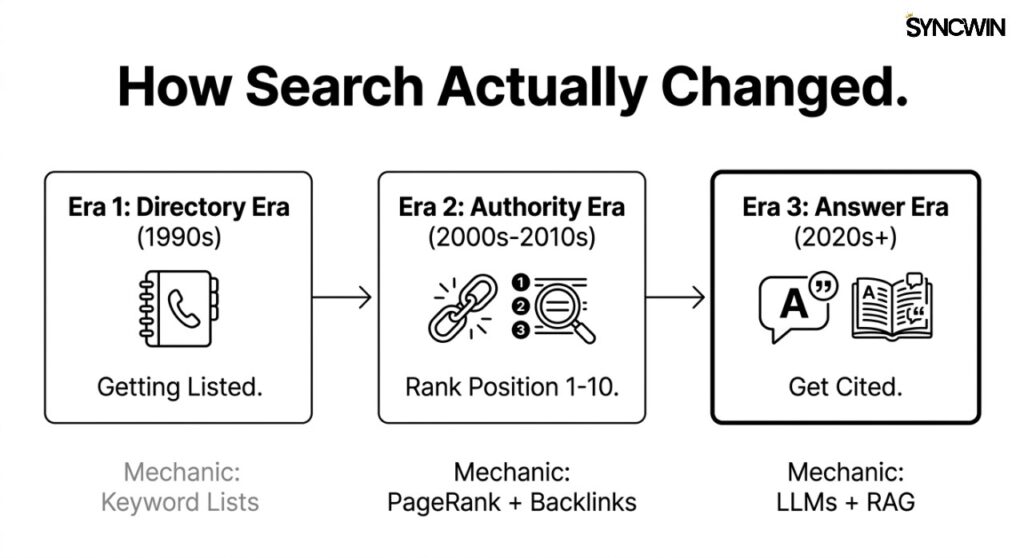
The Answer Era is not arriving in these markets. It is already running.
In the Directory Era, a search engine was a catalog. You found a list and picked one.
In the Authority Era, Google built PageRank. The more credible websites linked to you, the higher you rank. SEO became the discipline of earning those signals.
Now we are in the Answer Era. The search engine no longer shows you a catalog. It reads the catalog for you and provides a summary report.
That shift changed everything about how your content needs to be structured.
The pace of this shift varies by market, but no region is untouched.
In the United States, 58% of small businesses now use generative AI tools, nearly double the 40% recorded in 2024 (U.S. Chamber of Commerce, August 2025).
ChatGPT alone processes 2.5 billion prompts every day and has 800 million weekly active users globally (Exploding Topics, 2025).
Google AI Overviews, which appeared in 6.49% of searches in January 2025, now cover over 50% of all queries (SEMRush, SingleGrain).
In India, enterprise AI deployment is at 57% nationally, with 74% of early adopters accelerating investment in the prior 24 months.
India also leads globally among SMBs, with 59% already implementing AI-driven solutions in daily operations (IBM).
RAG (Retrieval-Augmented Generation): This is the system most AI platforms use to pull in real-world information before generating a response.
The AI does a quick research pass, extracts the most structured and trustworthy content it can find, and builds its answer from that.
If your content is clean and structured, it gets pulled in. If it is buried under narrative padding, it gets skipped.
The Core Difference: Relevance vs Extractability
This is where most comparisons miss the point.
Traditional SEO is fundamentally about relevance.
You match a page to a query using topical signals, keywords, and authority. The user sees your link, clicks, and lands on your site.
AEO is fundamentally about extractability.
An AI needs to be able to lift a specific fact or explanation from your page and use it to ground a generated response. If it cannot extract it cleanly, your content does not exist in that answer.
If you are not familiar with AEO yet, this guide covers what Answer Engine Optimization is and how it works before you get into the comparison.
A page can rank in the top 3 on Google and still be invisible in ChatGPT responses if its structure makes extraction difficult.
On the other side, a newer page with clean answer capsules and schema markup can show up in Perplexity citations before it ever cracks the top 10 organically.
The strongest pages in 2026 do both: they open with a 40-60 word direct answer for AI extraction, then go deep with data, examples, and expert context for human readers and long-term SEO authority.
How Each Platform Retrieves Content
One thing most AEO guides do not tell you: ChatGPT, Perplexity, and Google AI Overviews each pull from different sources using different logic.
A strategy that gets you cited in one will not automatically work for the others.
| Fresh content with a direct Q&A structure | Primary Source | Retrieval Bias | What Gets You Cited |
|---|---|---|---|
| Google AI Overviews | Google Search Index | Existing organic rank (top 1-5) | Strong core SEO and E-E-A-T signals |
| Perplexity AI | Real-time open web | Recency and source diversity | Mentions in Wikipedia, Reddit, and established publishers |
| ChatGPT Search | Training data + Bing | Brand authority and news media | Mentions in Wikipedia, Reddit, established publishers |
The overlap in citations across these three platforms is small.
Research confirms that a “one-size-fits-all” approach to AI visibility does not work.
What this means practically:
For Google AI Overviews, the relationship between organic rankings and AI citations is shifting fast.
In late 2024, around 75% of cited URLs also ranked in the organic top 10. By February 2026, that URL-level overlap had dropped to 17-38% (Ahrefs and BrightEdge).
What that means for you:
SEO is still the strongest foundation, but ranking first no longer guarantees AI citation.
Topical coverage across multiple formats and freshness of content now carry more weight than any single top-10 position.
For Perplexity, recency matters more than authority. Fresh, structured, direct content that answers a specific question can surface faster than an older high-authority page that buries its answer.
For ChatGPT, being a named entity in established datasets (Wikipedia, Reddit, LinkedIn, Wikidata) is more important than any specific keyword optimization.
Your off-site presence is what builds trust here.
What Zero-Click Actually Means for Your Business
In 2024, 58.5% of US Google searches and 59.7% of EU searches ended without anyone clicking a link (SparkToro/Semrush).
For every 1,000 searches in the US, only 360 clicks reach the open web.
When an AI Overview appears at the top of a results page, CTR for the top-ranked informational results drops from 1.76% to 0.61% (Search Engine Land).
That is a 65% reduction in clicks from a position you already earned.
But the impact is not uniform across all search types.
| Search Intent | Impact of AI Overviews | Right Strategy |
|---|---|---|
| Informational | Severe CTR drop | Optimize for citation and brand recall |
| Navigational | Low impact | Traditional SEO for branded terms |
| Transactional | Moderate impact | AEO for comparisons, SEO for UX |
| Local | High opportunity | GBP + local schema + NAP consistency |
Informational queries are being absorbed by the SERP interface.
If your entire traffic model depends on people searching “what is X” and clicking through to your article, that model is under real pressure.
The US market shows how quickly this reshapes real businesses.
Forbes and HuffPost each lost 50% of their organic traffic between 2024 and 2025 despite maintaining strong AI citation numbers.
The Washington Post dropped 40%.
Overall, organic traffic to US news websites fell from 2.3 billion monthly visits in mid-2024 to under 1.7 billion by May 2025, a loss of over 600 million monthly visits in under a year (The Digital Bloom, 2025).
For small businesses, the stakes are different: they are not losing 600 million visits, but the same structural shift is compressing the clicks that local service pages, how-to content, and informational landing pages used to generate reliably.
Transactional and local searches still drive clicks, because users need to interact with a website to complete a booking, purchase, or call.
That is where SEO remains critical and where local AEO is an immediate opportunity.
Why AEO Traffic Is Worth More
Here is where the data gets interesting. And I want to be upfront about the context before citing it.
These figures come from a 2025 Discovered Labs study of 12 million website visits and aligned B2B case studies across SaaS and professional services (Discovered Labs, 2025).
The SEO baseline of 2.6-2.8% is consistent across multiple independent 2025 sources (Martal, Ruler Analytics, FirstPageSage).
The 14.2% AEO conversion figure reflects B2B contexts where AI pre-qualifies the visitor.
Local service businesses, e-commerce, and B2C verticals will see different numbers, but the directional gap holds across every study on the topic.
The exact numbers will differ for local service businesses, e-commerce, and other verticals.
That said, the directional truth holds across every study I have seen.
| Performance Metric | AEO-Focused (90-120 days) | Traditional SEO (6-12 months) |
|---|---|---|
| Average Conversion Rate | 14.2% to 16.9% | 2.8% to 3.1% |
| Lead Qualification Rate | 67% sales-qualified | 23% sales-qualified |
| Cost Per Acquisition | 48% to 54% lower | Baseline |
| ROI | 287% to 415% | Variable, longer timeline |
Source: Multiple B2B case studies, Discoveredlabs and Reveation.io, 2025–2026. Results will vary by industry and implementation.
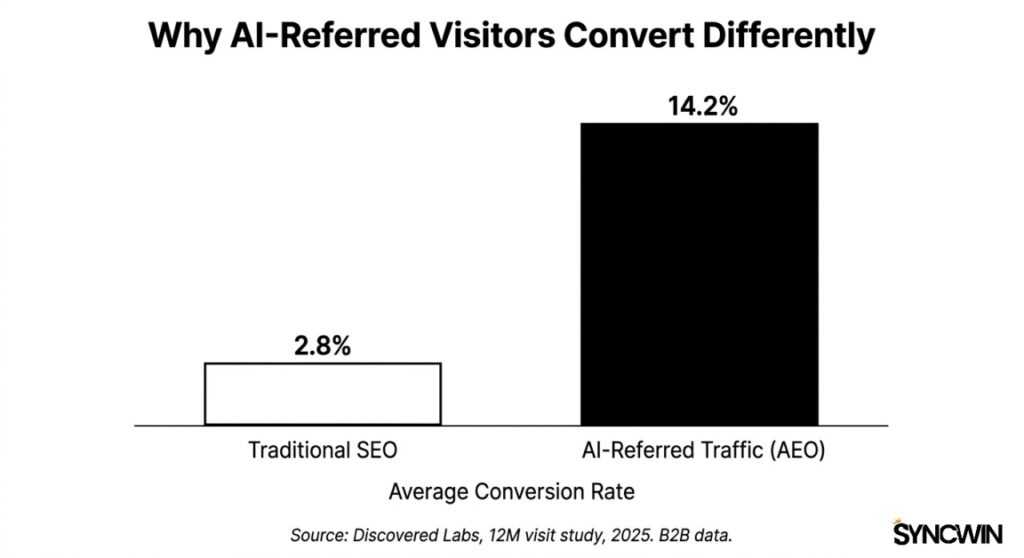
The reason for the higher conversion rate makes sense when you think about how people use AI.
When someone asks ChatGPT, “best digital marketing agency for a small restaurant in Kolkata,” and an AI recommends a specific agency, that person does not go back to scroll through ten more options.
The AI already did the vetting.
By the time they click through, they have a level of trust that no traditional blue link can build on its own.
To be honest, a part of this is also that many people, especially those who are not deeply technical, treat AI answers the way an earlier generation treated encyclopedia entries: if it says so, it must be right.
That is a real behavior pattern, and it directly inflates the conversion rate of AI-referred visitors.
Traditional search shows a list. AI gives a recommendation. Those are two fundamentally different starting points for a sale.
The Full Comparison: SEO vs AEO Side by Side
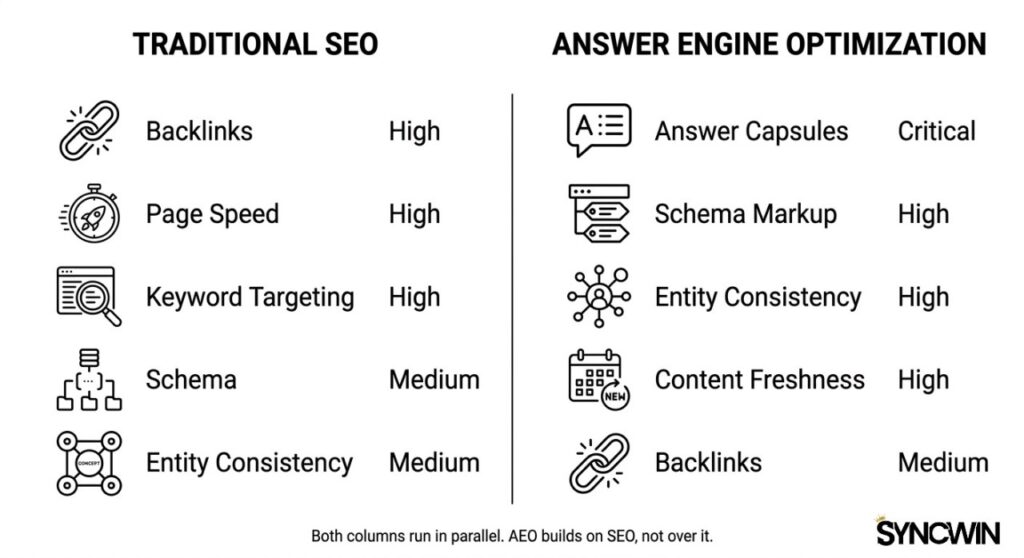
| Factor | Traditional SEO | Answer Engine Optimization |
|---|---|---|
| Primary goal | Rank in search results, earn clicks | Be cited in AI-generated answers |
| Content format | Long-form, keyword-optimized articles | Modular answer capsules + depth below |
| Success metric | Organic sessions, CTR, rank position | Share of Model, citation frequency |
| Technology | Crawler-based indexing, PageRank | LLMs, RAG systems |
| User interaction | User browses multiple results | AI delivers one synthesized answer |
| Backlinks | High priority | Medium priority (trust signal) |
| Schema markup | Medium priority | High priority (extraction layer) |
| Page speed | High priority (UX + ranking) | Medium (secondary for LLM scraping) |
| Answer-first structure | Low priority | Critical |
| Entity consistency | Medium priority | High priority (Knowledge Graph) |
| Content freshness | Medium priority | High priority (AI avoids stale data) |
| FAQPage schema | Optional enhancement | Near-mandatory for citation |
| Time to results | 6 to 12 months | 2 to 4 months for citation visibility |
| Kolkata/India readiness | Adopted by some businesses | Almost entirely untapped |
What Actually Works in 2026: The Layered Approach
Choosing between SEO and AEO is not the right question. The right question is: how do you build content that does both?
The answer is a layered structure.
Every strong page in 2026 opens with a 40-60 word answer capsule that directly addresses the main question.
This is what AI extracts. Below it, the page expands into supporting data, step-by-step context, tables, and expert-level depth.
That is what earns the backlinks, the time-on-page, and the organic authority that feeds the AI systems in the first place.
Beyond content structure, AEO requires one thing that most SEO work ignores: entity clarity.
Entity: A “thing” that an AI can identify and trust as distinct.
Your business, your founder, your services, and your location are all entities.
The more consistently they appear across your website, your GBP, Wikidata, LinkedIn, and your local directory listings, the more confidently an AI can cite you.
Knowledge Graph: The connected map of those entities.
When your website says you are a digital marketing agency in Kolkata, your GBP says the same thing, your LinkedIn confirms it, and your Wikidata entry references all three, the AI has a consistent, multi-source picture of who you are.
That is what gets you cited.
Key technical additions for AEO:
- Organization and Person schema: Establishes your business and team as verified entities
- FAQPage schema: Maps question-answer pairs directly for AI extraction (increases citation probability by up to 2.7x)
- sameAs property: Links your website entity to external profiles (LinkedIn, GBP, Wikidata), telling AI systems these are all the same trusted entity
- llms.txt file: A plain-text file at your domain root with verified facts about your business, reducing the chance of AI hallucinating incorrect information about you
My Take: Where Small Businesses Should Actually Start
I get asked this regularly now, so let me be direct about it.
If you have decent SEO already in place and zero AEO, start with the technical layer: add FAQPage schema to your top service pages, restructure your headers as direct questions, and add a 50-word answer capsule below each one.
That alone moves the needle faster than most people expect.
If you have neither SEO nor AEO, start with the foundation.
Get a proper website.
Do on-page, technical, and off-page SEO with AEO in mind from day one: that means writing content with topical depth and answer-first structure simultaneously, not as two separate projects.
Build your Google Business Profile, set up 2-3 social platforms you can post on consistently, and make sure your business name, address, and phone number are identical everywhere they appear online.
Whatever you do, on-page SEO, technical SEO, and off-page SEO are required before AEO tactics will have any meaningful effect.
The foundation has to exist. The AI has to have a reason to trust your content before it will cite it.
The Indian and Kolkata Market Reality
To be honest with you, the Kolkata market is behind on SEO, let alone AEO.
A significant number of local businesses, from restaurants to clinics to event venues, still do not have a proper website or a complete Google Business Profile.
The reasons vary: some have not found a reliable service provider they trust, some do not know where to start, and some are still skeptical about whether digital presence translates to real business.
That gap is a problem for those businesses.
For any local business that does take this seriously right now, the competitive advantage is real and it is available today.
India’s AI market is projected to grow from $13 billion in 2025 to $131 billion by 2032 (Fortune Business Insights).
The businesses that build a structured digital presence now, before that growth matures, are setting up a position that will be far harder to establish in two years when the market gets noisier.
A doctor’s clinic in South Kolkata that has a clean website, a fully built-out GBP, Bengali (if possible), and English FAQ content, and proper local schema is already ahead of 90% of its local competition in AI discoverability.
It does not need to outrank national health platforms. It just needs to be the clearest, most structured local answer when someone asks “best dermatologist near Ballygunge” in ChatGPT or Google.
I am currently building and tracking local AEO projects in Kolkata across multiple business categories.
When real results come in, they go up here as case studies, with actual numbers.
12-Month Roadmap: Integrating SEO and AEO
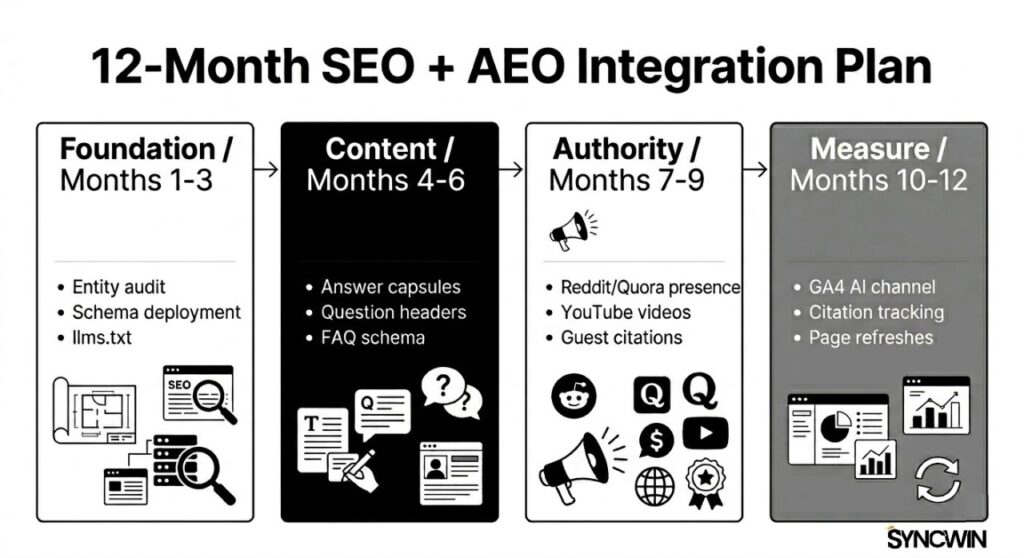
Phase 1: Foundation (Months 1-3)
Focus on entity clarity and technical stability.
- Audit your business entity: consistent name, address, phone, and description across every platform
- Deploy the Organization, Person, and LocalBusiness schema across site templates
- Add sameAs links from your schema to LinkedIn, GBP, and any Wikidata entry
- Create a Wikidata entry for your business if you meet the identifiability and verifiability criteria
- Add an llms.txt file to your root domain
Phase 2: Content Adaptation (Months 4-6)
Restructure your content for machine readability.
- Audit your top 20 performing pages and add 40-60-word answer capsules at the top of each section
- Rewrite H2 and H3 headers as direct questions
- Use “People Also Ask” data to build FAQ blocks on every service page, backed by the FAQPage schema
- Group existing content into pillar and cluster relationships to build topical authority
Phase 3: Off-Site and Multi-Source Authority (Months 7-9)
Expand your brand presence across the platforms AI trusts.
- Participate in relevant Reddit and Quora threads in your niche. Your brand name appearing in those datasets matters for ChatGPT specifically
- Create 3-5 short explainer videos for YouTube. Both Perplexity and Google AI Overviews are increasingly embedding video
- Pursue guest posts or citations in industry publications that AI engines treat as authoritative
Phase 4: Measure and Refine (Months 10-12)
- Set up GA4 custom channel groups to isolate and track AI-referred traffic separately
- Run manual tests in ChatGPT, Perplexity, and Google for your key queries. Document whether you appear
- Use tools like Semrush or Profound to track citation velocity
- Refresh high-leverage answer pages with updated statistics and current examples
AEO vs. SEO FAQs
Can I do AEO without doing SEO first?
Technically, you can implement AEO tactics without SEO in place, but they will not produce results.
Google AI Overviews pull 92.36% of citations from pages already ranking in the organic top 10 (Ahrefs).
Perplexity and ChatGPT trust sites with established domain authority, consistent entity signals, and credible off-site mentions.
All of those come from SEO.
The foundation has to exist before the layer above it has anything to build on.
How is AEO different from GEO or LLMO?
These terms all describe variations of the same shift.
GEO (Generative Engine Optimization) and LLMO (Large Language Model Optimization) are used by different researchers and practitioners to describe similar practices.
AEO is the most widely used term for optimizing content so AI platforms can extract and cite it.
SEO is the umbrella.
All of these are layers underneath it.
Will my website traffic go down if I focus on AEO?
Informational traffic will likely decline over time regardless of whether you do AEO or not.
AI is absorbing those queries.
The business case for AEO is that the traffic that does arrive from AI citations converts at a significantly higher rate (14.2% versus 2.8% in B2B research) because the AI has already pre-qualified the visitor.
The volume drops. The quality rises. Track AI-referred sessions separately in GA4 so you can see this clearly.
How long does AEO take to show results?
Meaningful citation visibility can begin appearing within 2-4 months of implementing the core technical changes: schema, answer capsules, header restructuring, and entity consistency.
Consistent and defensible citation results take closer to 6 months.
This is faster than traditional SEO because you are optimizing for extraction, not waiting for Google’s authority signals to compound.
What is a Knowledge Graph, and do I need one?
A Knowledge Graph is a structured, connected map of the entities related to your business: your organization, your people, your services, your location, and how they relate to each other.
AI engines use this map to understand who you are with confidence.
You build it by deploying the Organization schema, adding sameAs links to verified external profiles, and maintaining consistent entity data across your site, GBP, LinkedIn, and Wikidata.
Every business that wants to be cited by AI needs one.
What is Wikidata, and is it worth setting up?
Wikidata is a free, publicly editable knowledge database maintained by the Wikimedia Foundation.
It is one of the primary grounding datasets used by major LLMs.
Unlike Wikipedia, it does not require your business to be “notable” in a journalistic sense.
It requires your business to be identifiable and verifiable with external sources.
For a small business, a well-sourced Wikidata entry provides a factual anchor that AI engines can reference with high confidence.
Is AEO relevant for local businesses in India?
Yes, and the opportunity is larger in India precisely because adoption is so low.
Most local businesses have not completed basic SEO, let alone AEO.
A local clinic or restaurant with a clean GBP, consistent NAP data, and structured FAQ content targeting local queries is already ahead of the vast majority of local competitors in AI discoverability.
The early-mover advantage here is real.
Which is more important: SEO or AEO?
This question is built on a false premise, the same way asking “which is more important: a building’s foundation or its walls?” does not quite work.
SEO is the foundation. AEO is what you build on top of it.
Start with on-page, technical, and off-page SEO.
Add the AEO structure as you create or update content.
Run both in parallel once the foundation is solid.
Conclusion
“SEO vs AEO” is a framing problem, not an actual decision you need to make.
SEO became Search Everywhere Optimization.
It was never just about Google, and it is even less about just Google now.
AEO is one specific layer of that, focused on being the content that AI platforms extract, trust, and cite.
The businesses getting this right in 2026 are not choosing between the two.
They are building content that does both: answer-first for machine extraction, deep and authoritative for human readers, and long-term organic authority.
The biggest mistake I see right now is small business owners either ignoring AEO entirely (“SEO is enough”) or chasing AEO tactics without a proper SEO foundation under them.
Both approaches produce the same result: invisible.
Build the foundation first. Add the AEO layer on top.
Keep your business data consistent everywhere it appears online. Update your top pages regularly.
The businesses that do this now, while the competitive landscape is still open, will be significantly harder to displace in 12 months.
If you are not sure where your business stands right now, start with an audit.
It will tell you exactly what to fix and in what order.
Running a business outside India, and want to know where your current site stands on both SEO and AEO?
SyncWin works with small businesses globally on technical audits, schema implementation, content restructuring, and full AEO setup.
Get in touch with SyncWin, and we will start with an honest assessment of where you are.
Based in Kolkata or West Bengal?
We work directly with local businesses on GBP optimization, NAP consistency across Indian directories, Bengali and English content, and complete AEO implementation.
We know this market, and we work at local rates. Contact SyncWin for local SEO and AEO services.
Drop any questions in the comments. I read every single one.