
AEO (Answer Engine Optimization), GEO (Generative Engine Optimization), and LLMO (Large Language Model Optimization) all describe the same core practice: structuring your content so AI platforms can understand, extract, and cite it.
The terms differ by who coined them, not by what they ask you to do.
For a small business, the practical steps behind all three are nearly identical.
Key Highlights
- AEO, GEO, and LLMO are three names for the same shift: optimizing content for AI-powered discovery platforms
- 94% of informational queries now end without a click when AI Overviews appear (LLMrefs)
- 83% of comparison queries (“best X vs Y”) are resolved by AI without the user visiting any website (Click Vision)
- The Princeton GEO study found that adding statistics and expert quotes to content boosts AI visibility by up to 40%
- TrustRadius lost 92.2% of organic traffic between 2024 and 2025 as AI absorbed review queries (SE Ranking)
- AI-referred visitors convert at 5% vs 4% for traditional organic search (SE Ranking)
- SEO is not dead. It has become Search Everywhere Optimization: get found on Google, AI platforms, social, and everywhere else people look for answers online
Three Acronyms. One Idea. Here Is Why That Matters.
If you have been reading about digital marketing recently, you have probably run into all three of these terms in the span of a week.
Different articles, different experts, different acronyms, all apparently describing something urgent that your business needs to do right now.
To be honest with you, the confusion is understandable. Because the people writing about these topics have not agreed on what to call this yet.
AEO was the first term to get real traction.
Then GEO appeared in academic research from Princeton, Georgia Tech, and IIT Delhi in 2024.
LLMO showed up in practitioner circles to describe a slightly different angle on the same problem.
Now all three coexist, and beginners are stuck trying to figure out if they need to do three different things or one thing with three names.
Here is my honest take: for a small business owner, these are the same thing.
Answer Engine, Generative Engine, and Large Language Model Engine are all just different ways of saying “AI platform.”
Optimizing for all three means the same thing in practice: make your content structured, factual, and machine-readable so AI systems cite your business instead of someone else’s.
If I could rename this entire discipline, I would call it what it actually is: Search Everywhere Optimization.
Because that is the reality now.
Getting found online is no longer about Google alone.
It is about AI platforms, social search, voice assistants, community forums, and everywhere else people look for answers.
SEO did not die. Its scope expanded.
With that being said, the three terms do carry slightly different emphasis at a technical level. Understanding that helps you read the research without getting lost.
The Plain-Language Definitions
What Is AEO (Answer Engine Optimization)?
AEO is the practice of structuring your content to satisfy zero-click intent: giving a direct, extractable answer to a specific question so an AI platform can use it without the user needing to click anywhere.
AEO predates the current AI boom. Its roots are in Google’s featured snippets and voice search for Siri and Alexa. The goal was always the same: be the answer, not just a result.
For a small business, AEO means: write a clean 40-60 word answer at the top of every section, use FAQPage schema to map your questions and answers, and structure your headers as direct questions that mirror how a person would ask an AI.
If you are not familiar with how AEO works in detail, the complete AEO guide on SyncWin covers the fundamentals before you go deeper here.
Practical example: A physiotherapy clinic in Kolkata adds a FAQ section to their service page with proper schema.
Someone asks Google Assistant “what does a physiotherapy session cost in Salt Lake?” The clinic’s structured answer appears directly in the voice response.
No click required, but the brand is imprinted.
What Is GEO (Generative Engine Optimization)?
GEO targets visibility within AI-synthesized summaries, the kind of multi-source responses that Perplexity, Google AI Overviews, and Bing Copilot produce when someone asks a complex question.
Where AEO aims for a single direct answer, GEO aims to be one of the trusted sources inside a longer AI-generated explanation.
Think of it as the difference between being the one person who answers a question and being one of the three experts the journalist quotes in their article.
The academic research that defined GEO (Princeton, Georgia Tech, IIT Delhi, 2024) identified nine specific content signals that make a page more likely to be included in generative summaries.
More on those in a dedicated section below.
Practical example: A bakery in New York optimizes its blog posts with original statistics about cake trends and includes quotes from a pastry chef with named credentials.
When someone asks Perplexity “what are the most popular wedding cake flavors in 2026?”, the bakery’s post is one of three sources cited in the response.
What Is LLMO (Large Language Model Optimization)?
LLMO targets the internal representation of your brand inside the training data and inference cycles of standalone AI models like ChatGPT, Claude, and Gemini.
It is less about search interfaces and more about whether the AI “knows” your business exists as a trustworthy entity.
If an LLM has encountered your brand name across multiple authoritative, consistent sources during its training, it is more likely to recommend you in a conversational context, even without a live search retrieval.
LLMO priorities are entity consistency, off-site brand mentions, and being referenced in datasets the model trusts: Wikipedia, Wikidata, Reddit, LinkedIn, and established news outlets.
Practical example: A small SaaS company earns mentions on three industry blogs, a Reddit thread, and a Wikidata entry.
A year later, a user asks ChatGPT, “What are good tools for small business invoicing?” without any search retrieval, and the tool appears in the response because its entity is grounded in the model’s training data.
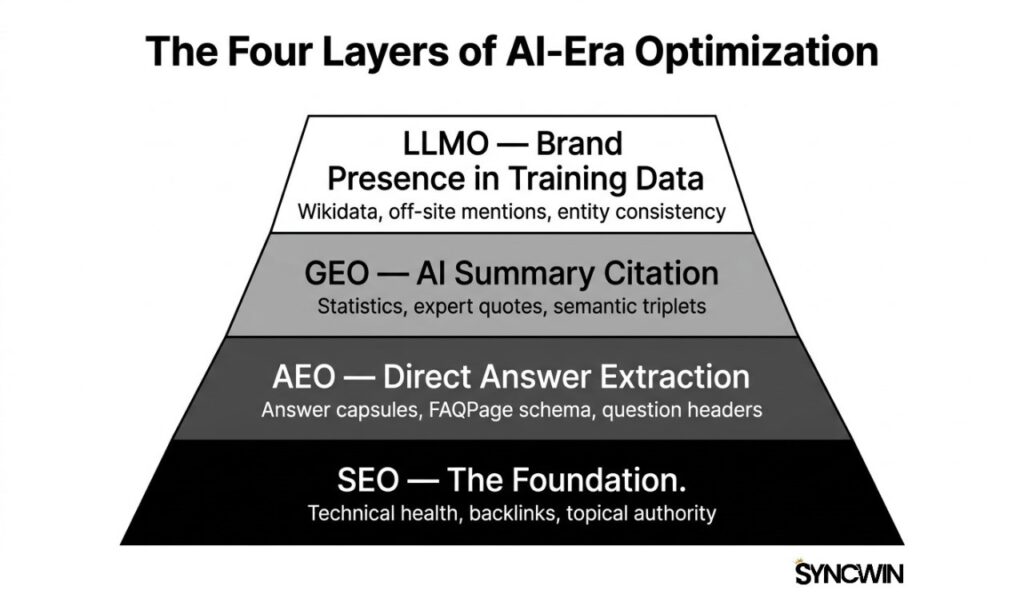
The Full Comparison: All Four Disciplines Side by Side
| Factor | SEO | AEO | GEO | LLMO |
|---|---|---|---|---|
| Primary target | Google/Bing SERP | Featured snippets, voice, PAA | AI-synthesized summaries | Conversational AI responses |
| Key platforms | Google, Bing | Google Assistant, Siri, Alexa | Perplexity, AI Overviews, Bing Chat | ChatGPT, Claude, Gemini |
| User intent served | Information retrieval | Quick answers and actions | Comprehensive understanding | Conversational discovery |
| Goal | Rank and earn clicks | Be the direct answer | Be cited in a summary | Be recommended by AI |
| Success metric | Rank position, CTR | Snippet share, PAA occupancy | AI Inclusion Rate (AIR) | Brand mention rate in AI |
| Content format | Long-form, keyword-optimized | Short, extractable answer capsules | Multi-source, citation-worthy depth | Consistent entity signals across web |
| Schema priority | Medium | High (FAQPage, HowTo) | High (Organization, Speakable) | High (sameAs, Person, Organization) |
| Backlinks | Critical | Moderate | Moderate | Low (off-site mentions matter more) |
| Freshness signal | Medium | High | High | Low (training data is periodic) |
| Entity consistency | Medium | High | High | Critical |
| Off-site presence | Backlinks | Brand mentions | Third-party citations | Authoritative dataset mentions |
| Time to results | 6-12 months | 2-4 months | 2-6 months | Months to years (training cycles) |
| India/Kolkata readiness | Partially adopted | Almost untapped | Near-zero | Near-zero |
All four run in parallel. None replaces the others. SEO is the foundation. AEO, GEO, and LLMO are the layers built on top of it.
How the Three Relate to Each Other (This Is the Part Most Guides Miss)
Most articles about these three terms present them as competing frameworks and then tell you to pick one.
That framing is wrong, and it leads beginners into a dead end.
Here is the accurate picture.
SEO is the foundation. It always was.
Without a technically healthy site, topical authority, and credible backlinks, none of the three AI-focused disciplines will produce results.
The AI platforms do not cite random websites. They cite trusted ones. Trust is built through SEO.
AEO, GEO, and LLMO are then three angles of the same overlay.
AEO focuses on single-answer extractability. GEO focuses on being cited inside a multi-source synthesis. LLMO focuses on being embedded in the AI’s knowledge base itself.
In practice, the tactics that serve one almost always serve the others.
Writing a clean answer capsule (AEO) also makes you more likely to be cited in a Perplexity summary (GEO).
Earning a Wikidata entry and consistent off-site mentions (LLMO) also builds the entity signals that Google AI Overviews look for (GEO).
There is no meaningful conflict between the three.
The AEO vs SEO article on SyncWin goes deeper into why SEO is still the foundation, and AEO builds on top of it. If you want the full breakdown of how the two relate, before continuing here.
The practical question for a small business owner is not “which one do I do?”
It is “in what order do I build these layers?” The answer is always: SEO core first, then AEO structure, then GEO depth, then LLMO brand presence.
The Princeton GEO Research: 9 Tactics That Boost AI Visibility by Up to 40%
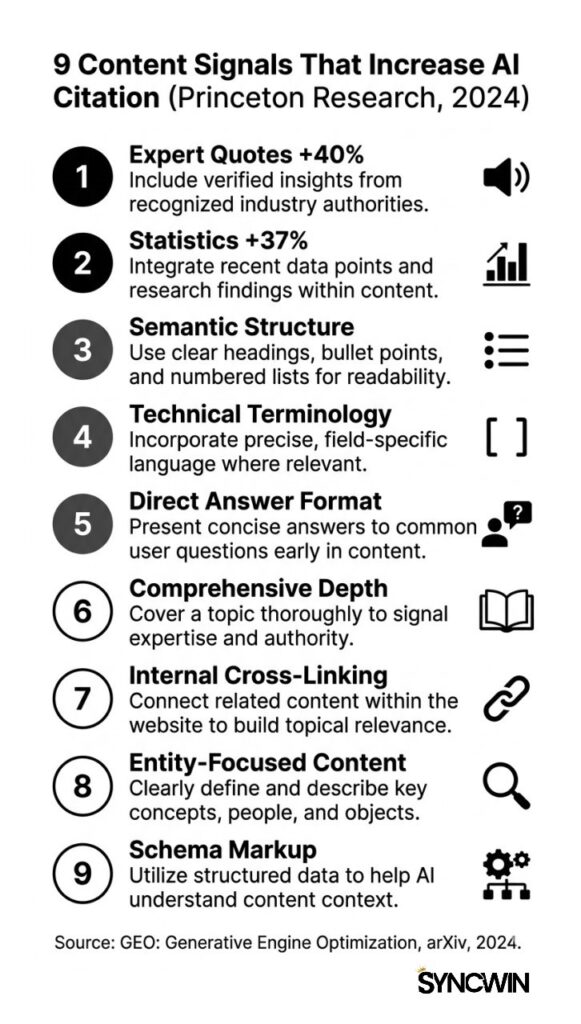
In 2024, researchers from Princeton University, Georgia Tech, and IIT Delhi published what is still the most rigorous academic study on GEO.
They tested nine specific content changes and measured the impact on visibility in generative AI responses.
Here are the nine tactics, translated into plain language, your business can act on.
| Make deterministic statements (“X causes Y”), not vague ones (“X may affect Y”) | What It Means in Practice | Visibility Impact |
|---|---|---|
| 1. Add statistics | Include specific numbers, percentages, or data points from credible sources | +37% (highest single tactic) |
| 2. Add expert quotes | Include a named person with verifiable credentials saying something specific | +40% (strongest overall) |
| 3. Cite your sources | Reference third-party reports by name (“According to a 2025 Semrush study…”) | Significant |
| 4. Write with authority | Make deterministic statements (“X causes Y”) not vague ones (“X may affect Y”) | Moderate-High |
| 5. Use plain language | Short sentences, clear structure, no jargon without explanation | Moderate |
| 6. Improve writing quality | Readable, well-paced prose (AI treats writing quality as a trust proxy) | Moderate |
| 7. Use technical terms correctly | Domain-specific language signals expertise to the model | Moderate |
| 8. Use distinctive vocabulary | Avoid generic web-scraped phrasing; write with a clear voice | Moderate |
| 9. Include relevant keywords | Still matters for the initial retrieval phase, less so for generation | Low-Moderate |
(Source: GEO: Generative Engine Optimization, arXiv, 2024)
The most important finding: tactics 1 and 2 (statistics and expert quotes) produced the largest jumps.
A page with a specific, sourced statistic and a named expert quote is significantly more likely to appear in a generative AI response than the same page without them.
The Semantic Triplet: The same research introduced a content pattern called the Semantic Triplet: Subject > Mechanism > Outcome.
Instead of writing “our service is effective,” write “SyncWin’s AEO implementation (Subject) adds FAQPage schema and answer capsules to service pages (Mechanism), which increases the frequency of AI citations within 90 days (Outcome).”
The deterministic structure gives an AI model a clean, low-ambiguity signal it can ground a response in.
The Zero-Click Reality: What These Numbers Actually Mean for Your Business
The economic argument for doing any of this is simple: the old model of “rank and get clicked” is breaking down for an entire category of queries.
The Review Platform Collapse
The clearest evidence of this shift is what happened to the major software review platforms between 2024 and 2025.
These are sites with massive domain authority, thousands of backlinks, and years of SEO work.
None of it protected them once AI Overviews started summarizing reviews directly.
| Platform | Traffic Decline (2024-2025) |
|---|---|
| TrustRadius | -92.2% |
| Capterra | -89.0% |
| Software Advice | -86.5% |
| G2 | -84.5% |
(Source: SE Ranking study, January 2026)
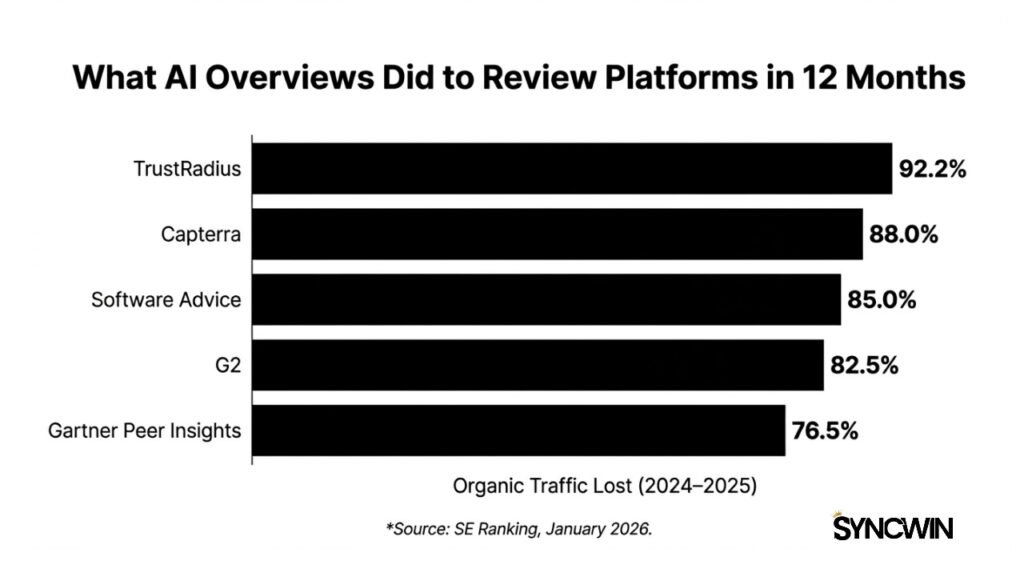
These are not small dips.
These are businesses built entirely on organic traffic, watching the majority of their visitors disappear in 12 months.
AI absorbed the queries. The clicks never arrived.
Zero-Click Rates by Query Type (2026)
| Query Type | Zero-Click Rate | What It Means |
|---|---|---|
| Informational (“What is X”) | ~94% | Almost no one clicks through for definitions or explanations |
| Any query triggering AI Overviews | ~83% | 8 in 10 searches where AI Overviews appear end without a click |
| Transactional / Purchase | ~56% | Over half of purchase-intent queries still end without a click |
| Branded / Navigational | ~35% | Users looking for a specific brand still click most of the time |
(Source: LLMrefs, 2026)
For a small business, the informational and comparison categories are the most urgent.
If you sell services and your website relies on “what is X” or “best X in [city]” queries for traffic, a significant share of that traffic is already being absorbed by AI answers.
The businesses cited inside those answers are the ones that stay visible.
Platform-Specific Strategies: Which Discipline Targets Which AI
Not all AI platforms retrieve content the same way.
Understanding what each platform favors helps you prioritize.
| Platform | Primary Retrieval Method | What Gets You Cited | Relevant Discipline |
|---|---|---|---|
| Google AI Overviews | Existing organic index (top 1-10) | Strong core SEO, E-E-A-T, structured data | SEO + AEO |
| Perplexity AI | Real-time open web, freshness-biased | Fresh content, direct Q&A structure, source citations | GEO |
| ChatGPT (with search) | Bing index + training data | Named brand entity, authoritative off-site mentions | LLMO + AEO |
| Gemini | Google index + Knowledge Graph | GBP data, sameAs schema, entity consistency | AEO + LLMO |
| Siri / Alexa / Google Assistant | Featured snippets, voice-optimized content | Speakable schema, short direct answers | AEO |
The practical implication: A strategy that only optimizes for Google AI Overviews (heavy SEO reliance) will underperform on Perplexity, where freshness and direct answer structure matter more.
A brand that has done LLMO work (Wikidata entry, Reddit presence, consistent mentions) will perform better in ChatGPT’s training-data responses than a brand that only has strong on-page SEO.
All platforms reward well-structured, factual content. But the weight given to each signal differs.
USA vs India: The Same Shift at Different Speeds
The underlying change is global.
The pace of adoption, the market maturity, and the specific tactics that make the biggest difference vary significantly between markets.
United States
The US market is the most mature in terms of AI search integration.
By early 2026, 25% of all US searches triggered an AI Overview (Single Grain).
Organic traffic for informational queries dropped by up to 60% across major publishers (Search Engine Land).
Forbes and HuffPost each lost approximately 50% of organic traffic despite maintaining strong AI citation numbers, meaning they were being cited but not clicked.
In the US, the most critical differentiator is earned media: third-party mentions on authoritative news sites, industry publications, and review platforms that AI models treat as credible signals.
Brand-owned content alone is not enough. The AI needs to see your business validated by external sources it already trusts.
US businesses are also early adopters of AI visibility monitoring tools.
Tools like Sight AI and LLMrefs now track brand mentions across ChatGPT, Claude, and Perplexity, providing an “AI Visibility Score” that functions as the Share of Model metric in practical dashboards.
India
India’s AI adoption among small and medium businesses sits at 59%, the highest SMB adoption rate globally (Forbes).
The enterprise AI deployment rate nationally is 57%, with 74% of early adopters having accelerated investment in the prior 24 months (IBM).
Despite this, most local businesses in Kolkata, India, from clinics to caterers to event venues, have not completed basic SEO, let alone AEO or GEO.
Many still do not have a properly built website or a complete Google Business Profile.
That gap is the opportunity.
A restaurant in Park Street or a clinic in Ballygunge that builds a clean, structured, entity-consistent digital presence today is establishing a position that will be significantly harder to create in 18 months when local competition catches up.
Hyperlocal specificity matters here in a way it does not in the US market.
Content that mentions specific neighborhoods (Salt Lake Sector V, Howrah, New Town Action Area), pin codes (700091), and local landmarks gives AI engines the geographic anchor they need to match your business to a “near me” query.
Regional language content in Bengali adds another layer of discoverability that almost no local competitor has built yet.
India’s AI market is projected to grow from $13 billion in 2025 to $131 billion by 2032 (Fortune Business Insights).
The businesses with a structured digital presence already in place when that growth matures will be nearly impossible to displace.
Real-World ROI: What Happens When Businesses Actually Implement This
These are third-party case studies with verified outcomes.
SyncWin’s own client case studies from local and international projects are currently in progress and will be published here as they produce measurable data.
Case Study 1: Netpeak USA (E-Commerce) A drainage and water supply equipment store added conversational “Use Case” sections and structured markup to product pages, directly targeting AI extraction.
Result: Revenue from AI-driven traffic grew 120% in four months.
AI channel visits increased 693%.
AI traffic converted at 5% versus 4% for traditional organic.
Case Study 2: ABM Agency (B2B Industrial) A global titanium dioxide producer restructured technical sales documents into a web-based knowledge hub optimized for generative engine citation.
Result: 82% mention rate in ChatGPT for industrial queries, 84% reference rate in Google AI Overviews.
Over $90 million in pipeline influenced, $20 million in attributed revenue.
Case Study 3: Simplified SEO Consulting (Local Service) A small therapy practice in the US built AEO-friendly FAQ blocks and question-based content targeting local search intent.
Result: Moved from 1 ranking keyword to 23 in 90 days. 7,316 impressions in three months.
First-page rankings for 11 high-intent keywords.
Case Study 4: TrioSEO for EcomBalance (SaaS) Used “prompt research” to identify the exact questions founders ask AI about bookkeeping, then built content targeting those prompts specifically.
Result: 25+ qualified leads and $10,000 in new revenue from ChatGPT referrals.
Top 3 GEO ranking for the brand’s most valuable commercial prompts.
The pattern across all four: businesses that structured their content for AI extraction saw faster results and higher conversion rates than traditional SEO alone delivered (SE Ranking).
Protecting Your Brand: What to Do When AI Gets You Wrong
As AI becomes the primary discovery layer, AI hallucinations (incorrect or fabricated information about your business) become a reputational risk, not just an annoyance.
Hallucinations happen most often when an AI model faces a “data void”: it knows your business name exists but does not have enough grounded, consistent information to describe you accurately.
It fills the gap with plausible-sounding fabrications.
Four things that reduce hallucination risk:
1. Build a factual grounding page.
Create a dedicated “About” or “Brand Facts” page written in plain, neutral language: founding date, location, services, leadership, and what you do not offer.
Avoid marketing language on this page. State facts.
2. Deploy Organization and Person schema.
JSON-LD structured data explicitly labels your business facts for AI crawlers.
It reduces misattribution (where an AI credits a quote or claim to the wrong entity) and gives models a machine-readable source of truth.
3. Add sameAs links.
In your schema, include sameAs properties pointing to your LinkedIn, Google Business Profile, Wikidata, and Crunchbase entries.
This tells the AI that these are all the same verified entity, not multiple separate businesses with similar names.
4. Run quarterly brand audits.
Every three months, ask ChatGPT, Gemini, Claude, and Perplexity: “Who is [your business name]?”, “What services does [your business] offer?”, “Where is [your business] based?”
Document every error you find.
Submit corrections through each platform’s feedback tool.
The Practical Action Checklist: Five Layers in Order
Do not try to do all of this at once. Do it in sequence. Each layer depends on the one before it.
Layer 1: SEO Core
- Mobile-friendly, fast-loading site (especially critical for India’s mobile-first market)
- Clean internal linking structure and logical URL hierarchy
- On-page, technical, and off-page SEO fundamentals in place
- 2-3 social platforms with regular content, not all of them
Layer 2: AEO Structure
- Identify the top 50 questions your customers ask
- Add an FAQ section with the FAQPage schema to every service page
- Rewrite headers as direct questions
- Place a 40-60-word answer capsule at the top of each page section
Layer 3: GEO Authority
- Add one verifiable statistic (with source) per page section
- Include named expert quotes where relevant
- Write using the Semantic Triplet: Subject > Mechanism > Outcome
- Build a /about or /brand-facts page with Organization schema
Layer 4: LLMO Brand Presence
- Earn brand mentions on authoritative third-party sites through consistent content and digital PR
- Ensure NAP (Name, Address, Phone) consistency across all directories (Justdial, Sulekha, IndiaMart for India; major national directories for the US)
- Create or verify a Wikidata entry for your business
- Add an llms.txt file to your root domain to guide AI crawlers toward your best content
Layer 5: Monitor and Adjust
- Set up a GA4 custom channel group to isolate AI-referred traffic
- Run monthly manual tests in ChatGPT, Perplexity, and Google for your core service queries
- Document what you appear for and what you do not
- Refresh high-traffic pages with current statistics every 60-90 days
AEO vs. GEO vs. LLMO FAQs
Are AEO, GEO, and LLMO really different things or just different names?
In practice, they are different names for the same core shift: optimizing your content so AI platforms can understand, extract, and recommend your business.
The terms emphasize slightly different technical angles (direct answers vs synthesized summaries vs training data presence), but the tactics that serve one almost always serve the others.
For a small business owner, treat them as one discipline with three lenses.
Do I need to hire specialists for each of the three?
No.
A practitioner who understands AI-first content optimization will cover all three as part of the same strategy.
What you actually need is someone who understands both the SEO foundation and the AI-specific content layer on top of it.
Be cautious of anyone selling “GEO” or “LLMO” as a standalone service disconnected from core SEO.
Which of the three should I start with?
Start with AEO because it builds on existing SEO work and produces the fastest visible results: schema implementation, answer capsules, and question-based headers can be applied to existing content without rebuilding anything.
GEO and LLMO require more foundational work (entity consistency, off-site presence, Wikidata entries) and take longer to show measurable results.
What is the difference between a GEO and a Google featured snippet?
A featured snippet is a single-source, direct-answer extraction that appears above the organic results in traditional Google search.
GEO targets AI-synthesized summaries, where the AI draws from multiple sources and constructs a new response.
Featured snippets are AEO territory.
Multi-source AI summaries in Google AI Overviews, Perplexity, and ChatGPT are GEO territory.
What is an llms.txt file and do I need one?
An llms.txt file is a plain-text document placed at your domain root (yoursite.com/llms.txt) that guides AI crawlers toward your most important content in a format they can process efficiently.
Unlike robots.txt, which tells crawlers what to exclude, llms.txt tells AI models what to focus on.
It reduces the chance of hallucination by giving AI a curated, verified starting point.
Every business doing AEO or GEO work should have one.
How do I know if AI is citing my business right now?
Search for queries your customers would ask in ChatGPT, Perplexity, and Google with AI Overview enabled.
See if your business name appears. For more structured tracking, tools like Semrush, Profound, and LLMrefs offer citation monitoring.
Setting up a GA4 custom channel for AI-referred traffic (sessions arriving from chatgpt.com, perplexity.ai, gemini.google.com) gives you conversion data alongside visibility data.
Is this relevant for businesses in India and Kolkata specifically?
Yes, and the opportunity is larger in India precisely because so few businesses have started.
A local business in Kolkata with clean structured data, a complete GBP, consistent NAP across Indian directories, and FAQ content in Bengali and English is already ahead of the vast majority of local competitors in AI discoverability.
The early-mover advantage in this market is real and available right now.
What happens if I do none of this?
Your existing organic traffic for informational and comparison queries will continue to decline as AI Overviews absorb more of those searches.
Businesses that AI cites will receive pre-qualified, high-intent visitors who have already been recommended your business by an AI.
Businesses that are not cited will become progressively invisible to the segment of the market that now makes purchase decisions within AI interfaces. That segment is growing.
Conclusion
AEO, GEO, and LLMO are not three separate problems.
There are three descriptions of one fundamental shift: the way people find information online has changed, and the businesses that structure their content for AI extraction will stay visible while the ones still running a 2020 SEO playbook will quietly disappear from the queries that matter most.
For a small business, the path is not complicated.
Build the SEO foundation. Layer the AEO structure on top. Add GEO depth through statistics, expert attribution, and citation-worthy writing. Build LLMO presence by being consistently mentioned across the platforms AI models trust.
Do it in that order.
The businesses that do this now, before the local market in their niche catches on, are building a competitive position that is genuinely hard to displace later.
That window is open. It will not stay open indefinitely.
If you are working through what this means for your specific business, future posts in this series will cover each layer in depth: technical implementation, local AEO for Indian markets, content strategy for AI citation, and step-by-step schema guides.
Each one will include real data as it comes in from SyncWin’s own projects.
Outside India, and want to know exactly where your business stands across SEO, AEO, GEO, and LLMO?
SyncWin works with small businesses globally on technical audits, schema implementation, entity building, and full AI optimization strategy.
Get in touch with SyncWin, and we will start with an honest assessment.
Based in Kolkata or West Bengal?
We work directly with local businesses on GBP optimization, NAP consistency across Indian directories, Bengali and English content, and a complete AI visibility setup.
We know this market, and we work at local rates. Contact SyncWin for local SEO and AEO services.
Drop your questions in the comments. I read everyone.